Building a website in a linear way fails to meet the essential purpose of a website…
Approaching your website with technical or design aspects first is not as effective as starting with end goals and working everything towards those.
Begin with the end in mind
Write down the essential end-results the site is supposed to accomplish. These are likely similar goals to your business in general. A few examples to help jump start the process…
Gain more customers
Serve existing customers
Then move a level deeper to…
Specific Website End Goals
Communicate to a visitor the pain your company solves or the need it fills
Get people to sign up for your email list
Download a whitepaper
Contact you (form, email, phone)
Submit a support request
Once you have identified the things you want to happen, the rest falls into place. It is only at this point that you can properly fill in all the other site requirements to make sure these items are met. Aspects like…
Make sure the site loads quickly
Have content that drives traffic to get people viewing
Intentional layouts that make sure the important goals are met
We love helping companies come up with an end-to-end strategy for a website rebuild. Send us a message and we’d be happy to chat about your situation.
Wow! 2016 flew by! It was an awesome year for LimeCuda. We are grateful for so many wonderful clients and fun projects – we’re truly blessed. Like many businesses, the early months of summer were uncommonly tough sales-wise. And we’re fighting hefty health insurance hikes. But overall, 2016 has been our best year in terms of finding better tools, processes, and taking care of business.
Let’s take a trip back over 2016 and see what happened…
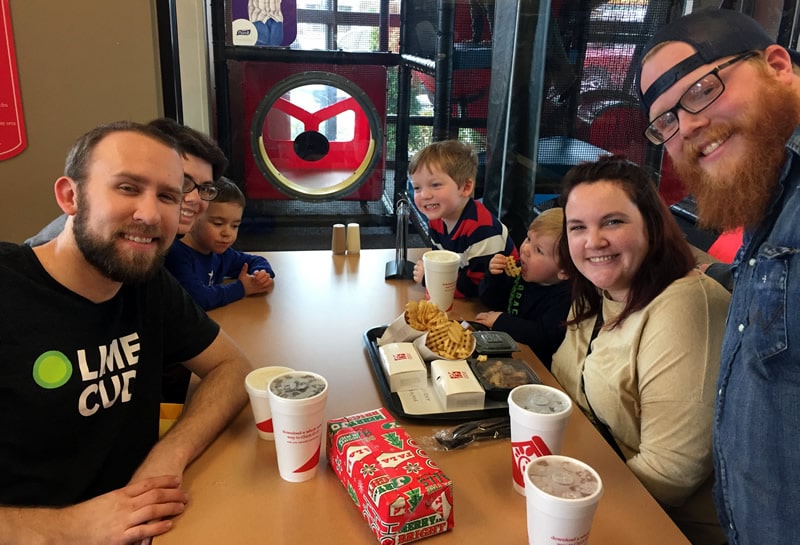
The Imeson and Mallard families meeting up for some chicken at a Chick-fil-a in Atlanta
Blake Imeson’s 2016 Story
Our family is now quite settled in Williamston, Michigan and mostly through with remodeling our house. We’re all deeply in love with the seasons of Michigan. Winter can be a bit long and gray but there are ways to break it up. We took two large family road trips to the South and back.
Our son is now 3 years old and is a hoot. He can name every two dimensional shape for you from a quatrefoil to a decagon… I somehow got my wife hooked on one of my great loves: buffalo hot sauce. I’ve been expanding my taste palette with sour beers and barleywines – Michigan is tops in the US for craft beer.
I finally gave my personal blog a fresh coat of paint and started publishing some posts. One of my new hobbies is fiddling with “Smart Home” technology – because who doesn’t want to get a text every time their fridge opens 😉
Josh Mallard’s 2016 Story
I almost died… I spent a few years with the most unhealthy of life and work habits that took a toll on my body. One day, late in March this year, it all caught up with me. You can read more about that story here.
Since then, I’ve learned how to maintain a more healthy lifestyle and am learning how to establish a manageable work/life balance. I’ve been rejuvenated like I haven’t been in a while and even had the energy to nag Blake into submission on the vision for a new brand for LimeCuda this year (see below) :).
Professionally, I’ve spent the remainder of the year building my technical skills through online courses, regular “playing around” with new technologies and ideas, and pushing forward on a few of the many plugin ideas that we’ve been toying with internally.
Personally, I’ve spent the year watching my boys grow up way too fast! It is sad to see them growing up so quickly but also exciting to experience these new phases of life.
I’ve also gained a new appreciation for yard work. Our yard was disturbingly overgrown when I first bought our house. I did a little work over the years but really only focused on having a few usable areas. Now, the process of clearing the brush and cutting down dead trees is actually one of the most relaxing parts of my week! There is something extremely satisfying about reclaiming our yard and envisioning all the new ways our boys can enjoy it once it’s all cleared.
LimeCuda
We got to know some truly wonderful people and are happy to also call them new clients…
Josh created a plugin for Gravity Forms that lets you add a download gate to get a whitepaper or other resource. This means that a visitor to your site will be required to complete a form of your choosing before being able to access your downloadable resources.
TECHNOLOGY
Secure All the Things!
2016 is the turning point year for websites being secured HTTPS (SSL / TLS). We’re now solidly in the era when all sites should be encrypting their traffic. The new free option of “Let’s Encrypt” makes SSL more readily available. If you haven’t moved to HTTPS yet, let’s talk!
WordPress Growing and REST API
WordPress now has a REST API. With this addition, we enter a new era of flexibility for the platform.
WordPress is being run on over 27% of the entire web and more than 60 percent of the top 100 sites on Inc.
Accelerated Mobile Project / Facebook Instant
These super-fast ways to load sites on mobile have hit maturity. Still really only applicable to content publishers but it has begun to shake up search results and impact user expectations.
On to 2017…
We have some exciting plans for 2017 (seriously!) and better serving you, our clients.
One of the greatest rewards for our efforts is seeing them actually help you run your businesses better, gain new customers, and help the web parts of your businesses turn from drudgery to fun!
So cheers to 2017! We’re hoping, planning, and praying it is going to be awesome!
A website redesign can be just the fresh start to reinvigorate your organization’s web efforts. We’re serious and this isn’t about building our business. Here’s why…
1. Web technology and design change quickly
Let’s look at just a few recent big shifts (dates are debatable and just for a rough idea)…
2008 Social Media becomes mainstream with Facebook and Twitter gaining widespread adoption. The stereotypical characteristics of Web 2.0 are starting to die out!
2010 Mobile revolution kicks into high gear. Your site had better look good on mobile / tablet.
2012 Broadband becomes ubiquitous through much of the industrialized world. Fast speeds mean sites can be more content rich with videos and big imagery
2015 A renewed focus on Site Speed as mobile use is accounting for a massive portion of traffic.
2016 Google AMP and Facebook Instant debut trying to help content publishers provide super-fast loading on mobile Securely encrypting your traffic (HTTPS) is suddenly best practice.
There are usually a few big impact changes within 2-3 years. These shifts I mention don’t even begin to talk about the massive changes in aesthetics and design!
Minimalism, Skeuomorphism, flat design, material design, waterfall layouts – design philosophy advances and improves all the time. A fun exercise is to use the Wayback Machine and see what your company site or your favorite sites looked like years ago.
A general rule of thumb is you likely need a new site or at least an evolved site every 3-5 years.
2. You likely know more about how your website is getting used
Hopefully you’ve been tracking how people use your site and know which pages they visit, how engaged they are with each, and the typical flows from one page to the next. Doing a redesign / rebuild forces you to confront this and ask honest questions about what should get cut out.
3. It shows your company is alive and thriving
A new site sends strong messages to your customers. It indicates to them that your business is doing well. It might help them feel the love with a site that better serves them. A new site is also a great time to drum up some PR and get some brand exposure.
What does a new redesign / rebuild entail?
A new redesign doesn’t have to be a complete upheaval or a total rebuild from the ground up. For many reasons a ground-zero rebuild may rock the boat SEO-wise. If you are already on a Content Management System you love (yay WordPress) you can likely just re-skin and modify layouts. This type of more superficial rebuild likely won’t result in you deleting pages or changing URLs which is some of the aspects that can give your SEO a shakeup.
Maybe “Evolutionary Redesign” is a better approach for you?
This may seem opposite from everything we’ve been saying up to this point but in many cases Evolutionary Redesign can be a better approach than an entirely new website.
Consider a more mild evolutionary (as opposed to revolutionary) approach only if most of these are true:
Your CMS is working well for you
The site has increasing and trackable success
The design is working and could be great with minor tweaks (e.g. fonts, padding)
The site works well on mobile / tablet
The site loads quickly
Your users give you positive feedback
If the above don’t hold true, it might be a sign that you need to pursue a more aggressive redesign / rebuild.
The aspects you may want to address in a redesign:
Aesthetics – does the site look dated? Does it still feel like the online representation of your offline brand?
Site navigation – which menu items are being visited and helpful. Might be time to clean up and re-order.
Are there elements that you should get rid of? Ads, banners, useless widgets, distracting sliders, neverending text? Approach the redesign with thoughtful strategy.
Are there elements like Social Media sharing, email signups, comments, etc. that were added one-by-one over time. Perhaps these can all be re-worked to be intentional harmonious parts of the design.
Take a look at your competitors. Are they doing new things that might be really smart to borrow some inspiration from?
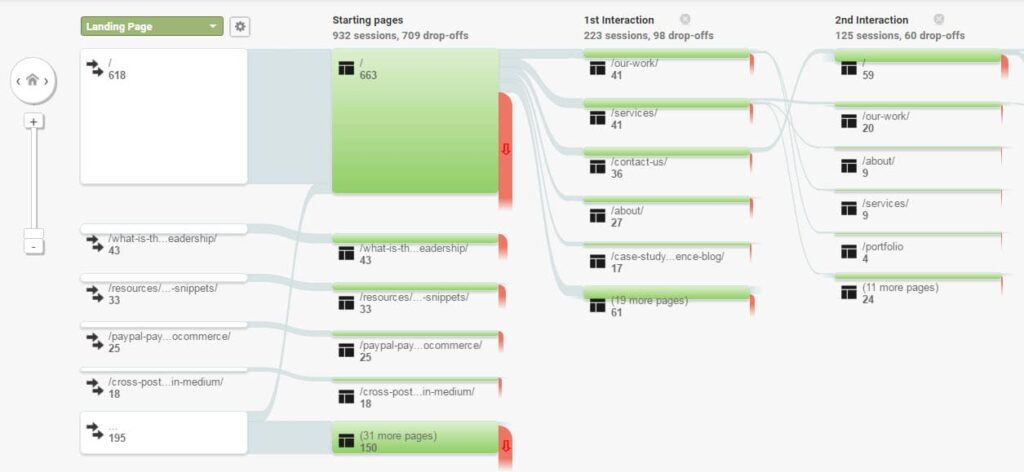
Dig deep into your analytics to see how people use your site. Google Analytics has some great behavior flow reports
Blogging can be a fantastic business tool. Getting rankings in Google feels like winning a major award. But it isn’t guaranteed…
The difficulty is – not every post is a winner. Sometimes you write something you think is great and it just flops. No rankings, no sharing, no comments. It’s painful.
But when you do hit the right nerve and the post is skyrocketing with traffic, top rankings, active sharing, everyone is commenting – it is a glorious feeling.
The Key is Persistence
You’ve got to keep writing knowing that sometimes it will be like a tree falling in the forest that no one hears. Many times you won’t be expecting a post to go anywhere and it blows you away. In a way, blogging is like rolling dice, occasionally you hit the jackpot. So keep rolling!
I thought it would be fun to share a few very unexpected “jackpots” we’ve hit.
Korean Ramen Noodles
On my personal blog I wrote a blog post sharing delicious Korean Ramen Noodles that I’m crazy about. Some Korean friends in college got me hooked on this spicy ramen. I wrote about it and how you can buy it on Amazon. Before I knew it I was getting traffic for all kinds of Korean Ramen related searches!
Takeaway: Share your passions and loves.
Accidentally Changed WordPress Site Address
This is my most commented post ever. Published over 6 years it has gained over 150 (grateful) comments and over 18k pageviews! It was born out of a very scary incident when I accidently took down my employer’s popular blog. In my post I shared the solution for if you’ve “accidently changed your WordPress site address“. Turns out people are still making this mistake haha.
Takeaway: Share problems you’ve faced and solutions you’ve found.
WordPress Hosting and Maintenance
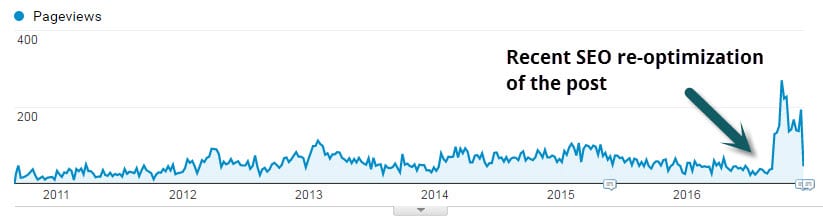
This is a recent one and frankly unplanned. We provide WordPress Hosting & Maintenance as a key ancillary service. This is a very competitive space and we’re playing with some very large companies. That aside, with a bit of work our hosting page is actually ranking on page 1 for “WordPress Hosting & Maintenance“!
Takeaway: Even if you are a small player you can rank for longtail keywords.
One of the most fun parts of our efforts with clients is helping them gain rankings that affect business! Keep blogging!
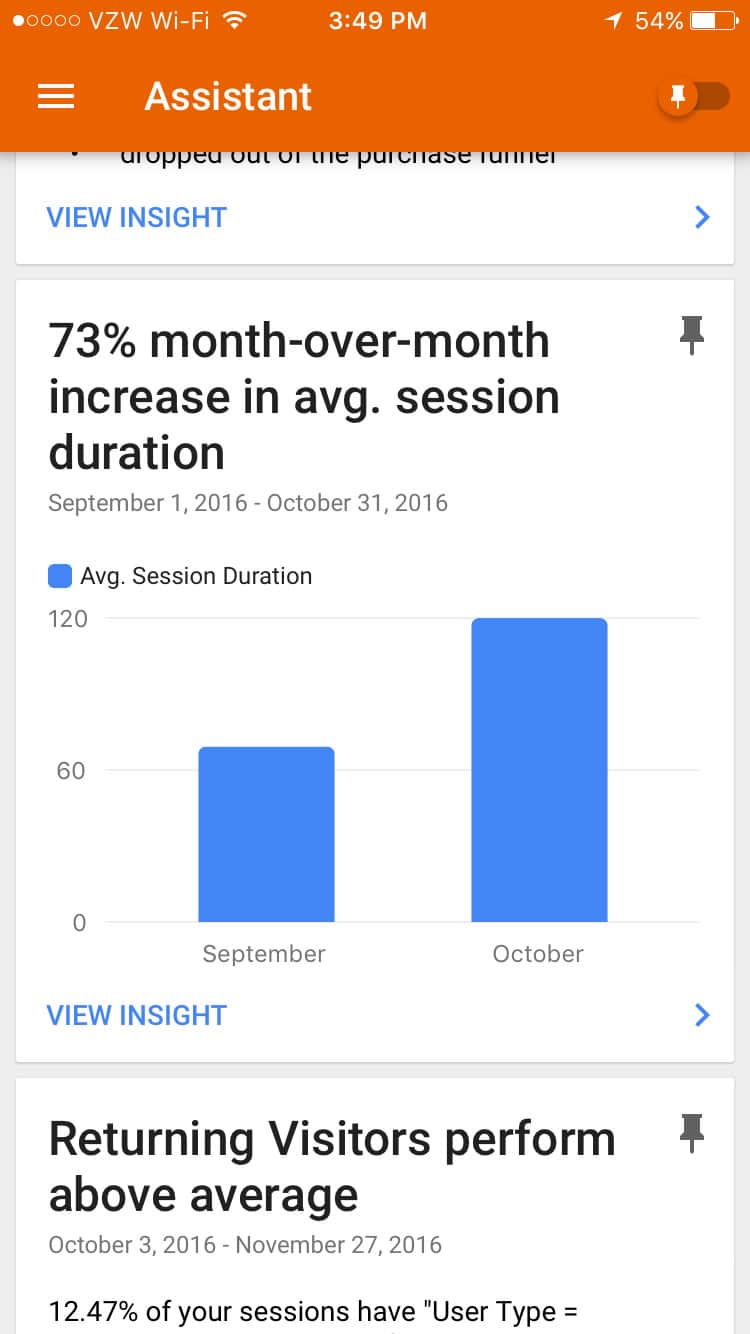
Google Analytics recently added a really neat tool called “Assistant” that gives you automatic “Insights”.
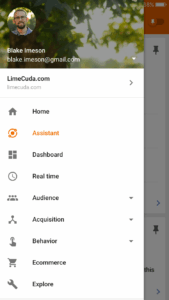
The tool is only available in the Google Analytics Mobile App (available for Android or iPhone) .
Examples of the kinds of goodies the app will give you:
As with all data you need to approach it with wisdom. Not all “insights” are actually insights.
The tool will give you positive and negative insights. Occasionally checking this might alert you to a site issue of which you weren’t aware. Conversely, you might discover one of your posts picked up some steam or a big site linked to you.
This handy Assistant feature is coming to the browser at some point I believe.
Go download the app and login to your Google account. You may find undiscovered gems in your analytics data.
What is “thought leadership”? Blake alluded to this concept when discussing finding your industry heroes. Let’s take a deeper dive into what “thought leadership” means and why it is important to you.
Thought leaders are the informed opinion leadersand the go-to people in their field of expertise. They are trusted sources who move and inspire people…
This is an excellent definition of “thought leadership”. I love the above quote from Denise Brosseau of the Thought Leadership Lab. It not only defines what a thought leader is, it also shows whybeing considered a thought leader in your industry is a huge asset for your business.
Becoming a Thought Leader to Build Trust
“They are a trusted source…”
If people like you they’ll listen to you, but if they trust you they’ll do business with you.
Thought leaders have earned the trust of their target audience. They’ve taken their existing assets of wisdom, time, and experience and transformed them into one of the most valuable assets you can have in the sales process and business relationships – trust.
Becoming a Thought Leader to Drive Action
“They are trusted sources who move and inspire people”
Selling can sometimes feel like the dirty part of doing business. We’ve gotten into our industries and built our businesses because we truly believe in what we’re providing – we know we have value to bring to the table. The core of selling is communicating that value.
By becoming a thought leader, you organically create the desire for your solution within your target audience. You become the driver for informing your audience on what they need. In turn, they trust your opinion and judgment. They trust your opinions on your own products or services but ancillary aspects of your industry.
How Does One Become a Thought Leader?
At this point, you may be thinking “That’s great! But how does that help me and my business. I’m not a thought leader”
This is where I get to be a bit of a buzzkill. There isn’t a guaranteed process or a checklist that you can complete to make you successful.
However, there are actionable steps you can start taking today that will help in building your reputation within your industry and help you in the pursuit of becoming a thought leader.
1. Create Content
The greatest thing you can do is to create content that specifically addresses the problems and pain your target audience is experiencing. This can be done via your own blog, guest posts on popular sites within your industry, writing e-books or publishing a traditional book – the list goes on.
This is also not just limited to written content. You can create videos or your own podcasts to allow your audience to digest the wisdom you’re sharing in the way that is most convenient for them.
2. Participate on Social Media
Even if you think your industry is boring, there is still a target audience for your voice on most Social Media networks. Don’t just generate and share your own brilliant thoughts but generously re-share other people who are contributing great thinking.
3. Public Speaking
Are there any industry conferences that you could speak at? Are there opportunities to speak to groups of your industry peers? These can be great opportunities to get your name out there and establish yourself as an authority within your industry.
4. Be Generous with Your Expertise
There is a counterintuitive reality that those who give generously are usually rewarded generously. Don’t be stingy with your counsel. There are appropriate times to charge for your expertise but adopt a position of freely sharing the wisdom you’ve gained.
We love seeing real-world examples. Share with us your “thought leadership” niche in the comments.
Pursue these common missed website opportunities and find sweet success with your online efforts.
1. Missing Strategy / Being Thought-less
I’m reminded of the classic line asked of you while checking out at the grocery store: “Did you find everything ok?”. Great, I’ve got 6 anxious people behind me in line and now is the time to help me locate curry powder?
We see companies forming their web presences in the same manner. You need to have thoughtful strategic intent behind every part of your website.
2. Forgetting to Track Traffic or Analyze It
It never ceases to amaze me when I discover a new client has never looked at their analytics or, even worse, has none at all.
It would be like a running a restaurant with the lights out. You wouldn’t know if the restaurant was busy or not. You can’t tell if potential customers are being served. You have no idea if table 10 got the correct order.
You can’t optimize and improve what you don’t track!
3. Not Pursuing Snappy Site-Speed
How fast a web page loads is key to a great user experience and whether people stick around to dig further. The difference between a 2-second page load and a 4-second page load can massively affect your site success. (Here’s a tool we like to check site speed)
4. Letting the Site’s Content Go Stale
Blogging is hard! (Here you go: 4 Blogging Tips) Your company may be fast-moving so keeping the service and team pages updated is a never-ending chore. But wow, can it make a big difference in how people judge your brand. (Don’t forget Social Media!)
Picture this…you look up a local restaurant. The last post on the restaurant’s Facebook page is from two years ago. Half the items on the menu are no longer made or the price has changed. You’ll likely move on to another restaurant option.
Some firms neglect their websites in the same fashion. Your website is an online representation of your offline brand. It is likely to be one of the first and most important impressions of your brand!
5. Neglecting A/B Testing and Conversion Optimization
This one is hard and the most excusable in this list. However, if you have a sufficient level of traffic and clear next steps (e.g. contact forms, email lists, etc.) there may be huge missed opportunity to improve your pitch.
As always, we’re happy to chat and see if we’d be a great fit to help your firm capture opportunities.
The 4th post in our 4-part series investigating the difficulties between IT and Marketing.
Changing the Way IT or Marketing Communicates
Marketing should keep a few things in mind when communicating with IT:
Fully communicate the end-state – the goal you wish to accomplish and not just what you want to do. IT can be a strong strategic partner in helping you accomplish your goals and not a vendor to do your bidding.
Leave specific requests as open-ended as possible. Don’t jump too quickly into dictating specific solutions. You will miss out on potential undiscovered opportunities IT can suggest and you will undermine the expertise that they can bring to the table.
Make requests to-the-point and cut out fluff. IT-types may disdain small talk.
Treat IT as a key partner in the trenches, not as a vendor.
IT should keep a few things in mind when communicating with Marketing:
Try to understand the end customer, the sales process, and the strategic goals of the endeavor.
Approach the situation with positivity and a success-orientation.
Make an effort to communicate in layman’s terms and don’t overuse acronyms.
Proactively ask for clarification – especially if you see a potential weak spot. Take the time to fully marinate in the problem space before you jump into solution mode.
Don’t perform a requested task exactly-as-asked if you know it will fail just to prove Marketing lacks depth of knowledge. It may puff your ego but it isn’t kind.
When engaging, you may need to be more warm and schmoozy than you are when interacting with exclusively other IT-types.
This was the final post in our series on IT vs. Marketing. We hope you enjoyed it and got some value from our perspective. We did take liberty and spoke in generalities, there is a wide swathe of situations and sometimes there is zero friction between these two groups.
We’d love to hear your thoughts on the subject! Please comment on any of the posts and add your two cents!
Need a firm to help bridge communication with IT / Marketing? We’d be happy to chat.
How to solve the friction and make the world a better place
We’ve seen four approaches that can work really well to solve the IT vs. Marketing conundrum.
1. Let One Group Lead and Take Ownership
We’ve seen this work but it can be really tricky. If Marketing takes ownership but doesn’t correctly care for the technical nuance of their endeavor they can end up making a mess of the site. While it might look pleasing and strategic, there are often gaping holes in technology interrelation, scalability, and/or weak security, to name a few common serious issues.
If IT takes the lead, the site might be built using the safest and most stable technologies but be extremely difficult for non-technical teams to manage. If they are not careful, IT could lock the site down in a “holding pattern” for years with no meaningful strategic readjustments or fresh content.
2. Partner IT and Marketing with Aligned Incentives and Common Goals
Have the project purpose and KPIs clearly defined so that all sides know where they are aiming. If there is maturity of leadership and a desire for success, this can certainly be a successful partnership.
3. Amalgamating IT and Marketing Together
For new companies and startups, it is common to no longer see a clear delineation between IT and Marketing. We think this can be a really enlightened approach if your business model will support it.
4. Third-Party Vendor Approach
A third-party vendor can be a solid bridge between IT and Marketing. Whether their role borders on U.N. Peacekeeping or is simply to be an interpreter for competing goals – a third-party vendor can bring much needed freshness to communication that has become stalemated in mature companies. At LimeCuda, we often find ourselves being “the vendor”.
A firm like ours is a hybrid mix of both IT and Marketing which means we are sensitive to the needs and concerns of both. Sometimes we work exclusively with Marketing-type folks and we play the role of “IT”. Other times we work closely with IT to integrate existing systems and alleviate their procedural and security concerns.
We are biased but an optimal solution may be a neutral third party both sides view as an expert.
Need a firm to help align IT / Marketing and coordinate your efforts on the web? We’d be happy to chat.
The second part in a 4-part series investigating the difficulties between IT and Marketing. Read Part 1: Why the Friction?
The Website, Troublemaker at the Center of It All
The website is a classic battleground of IT and Marketing. It’s like having a sibling who has all different interests as you EXCEPT for the same love interest. It is bound to get ugly.
Conversely, the website could be a hot potato for the two silos. Neither may want the ownership or responsibility of the website. Fighting to be relieved of the responsibility can be as ugly as fighting for control.
A Website is Equal Parts Technology and Marketing
By “website” I’m talking about the primary public website a potential customer visits in order to learn or buy from a company. Absolutely this could be an oversimplification. We have clients for whom we manage 12 websites.
Websites run on some sort of technology stack. They have technical components like a domain name, hosting, update caretaking, and a CMS. There is uptime, site speed, security, and a whole host of technically-oriented concerns.
But a website also needs to be highly strategic. It is usually a customer’s first impression. It has to be on-brand, positioned well, and tell the company’s story. It may leverage content marketing, analytics, Social Media, and SEO. All items that usually fall within the purview of Marketing!
Who’s to blame for the friction?
It is easy to chuckle while imagining the stereotypes for IT and for Marketing and assume this is where the trouble stems. The IT people are nerds, gruff, arrogant, and anti-social. The Marketers are jocks, gregarious, loud, and just drink all day like characters in Mad Men. Occasionally these may be somewhat true but really the diversity in both fields is increasing. We don’t think these personality penchants are really at the root of the issue…
This friction isn’t entirely the fault of IT or Marketing but they’re both rather unfortunate victims of a poorly constructed system of incentives. Our analysis is this friction usually stems from misunderstanding each other and misalignment of incentives. Next post coming up, how to find Success!