User Experience! Why Everyone Hates Your Website


At its most basic, User Experience (UX) design is exactly what it sounds like. You’re designing and working towards users having the best possible experience using your website or application.

This means they can quickly determine what your website is about, finding the information they’re looking for is a breeze, and accomplishing necessary tasks takes very little mental exertion. At the end of the process, the best UX allows for users to accomplish the primary purpose of your website with as little mental exertion as possible.

This is why one of the greatest books on the topic is called “Don’t Make Me Think“, users don’t want to have to think about what they’re doing. They just want to do it!

Where to start when thinking about UX?

UX design is a great field with many different techniques that can be employed to help in understanding how well users are able to interact with your website or application.

But, as a starting point for most people, the simplest step is to get out of your own head and think about your users – your potential clients.

Particularly if it is your own business, you’ve probably had your mind wrapped up in a lot of things that most clients don’t care about.

For example, you may take great pride in the interesting story behind the founding of your business. However, potential clients looking for your core service may find your story to be a hindrance if it gets in the way of them completing their main objective.

Align your objectives

If you’ve ever had a conversation with us you know we’re big on having a clear, and usually solitary, intention for your website. What do you want to accomplish? What is your objective?

So, when building a website you should have a clear objective. Your site is subsequently designed to meet and promote this clear objective.

So, at its core, I believe a great UX can only exist when the objective you set for your website is aligned to the objective a potential client has when visiting your website.

For a successful website, the two objectives must match.

This can only happen when you first take a step back and think about your user and not your business.
What are your potential customers looking for when they land on your website? Do they find it?

LimeCuda is now in East Lansing, Michigan

WordPress design East Lansing

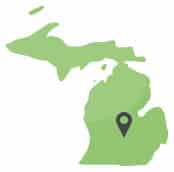
Big news for LimeCuda and myself (Blake): We’ve relocated to East Lansing, Michigan! We’re looking forward to using our WordPress expertise to help businesses in the East Lansing / Mid Michigan area.
Most of you are probably already aware of this as technically we moved a few months ago. But consider this the official announcement post.

This really won’t affect most of our customers or the way we serve you, except our mailing address has changed to:

[wpseo_address show_phone=”false” show_state=”1″ show_country=”1″ show_email=”0″]

LimeCuda will be turning 5 years old this coming January. We’ve seen a lot of change in ourselves, in the industry, and how we create web-solutions. We’re as excited as ever about helping organizations better harness the power of the web and we still truly love what we do.

WordPress All Over the World

wordpress

We began in Pennsylvania, moved to Florida, then Georgia, and now to Michigan. We have clients in 16 US states and 11 countries. The magic of the Internet age is we’re able to provide WordPress-centric solutions to clients all around the world – but if you are in our new neighborhood of East Lansing, Michigan we’d love to meet you!


The Mallard Family is Growing!

A couple of weeks ago, my wife and I welcomed our second son into the world, Hudson Forrester Mallard. We’re excited about the growing family and our 2 year old is happy to have “BABY!” around. He’s already started talking to him and reading him books 🙂

Hudson Forrester Mallard

Brothers

Family

Not Annotating in Google Analytics? You’re Missing Out

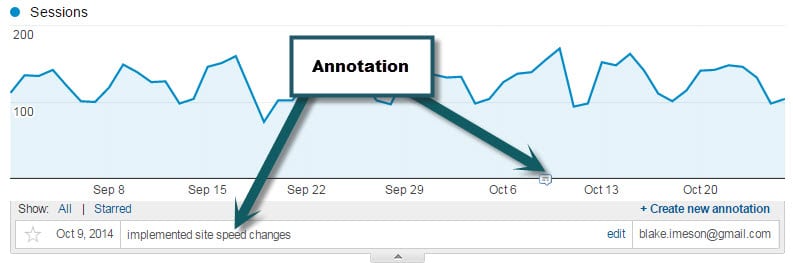
Have you ever made a change to your website hoping it will increase your traffic or specific conversions? How do you track the effectiveness of this change? One simple way to track your efforts is to take advantage of annotations within your Google Analytics account.

What are Annotations in Google Analytics?

google-annotation

Annotating in Google Analytics is simply recording a note that will always be visible. Simple but powerful. Take a look for yourself in the following screenshot.

What would be worth annotating?

  • Site re-launch
  • Major content changes
  • Email campaigns
  • Adding a new plugin

Basically, anything that could  in a meaningful way positively or negatively affect the traffic is worth adding. That way if you are going through your analytics history you might be able to trace back upswings or downswings to things that were done.

How do you annotate?

Super easy, just select the date range in Google Analytics that will encompass the date you want to annotate on and then click the “+ Create new Annotation” button.If you choose the option “shared” then your note will be visible to other users on the Analytics account which can be helpful for the team and for those that may follow after you.


Why Redirect Pages from Your Old Site?

404-not-found

Say you had a page on Blue Widgets on your old site – when you go live with a new site maybe you decided to delete that page or you changed the URL.

So what happens if someone tries to go to that page on your old site? They will hit an error page AKA 404 “Not Found” page. 

This is no bueno. In my somewhat-biased opinion whether this gets remedied or not can be a clue as to whether a developer is good or great.

So Why Redirect Defunct Pages?

If we don’t there are two primary negative effects:

1) The domain now has a bunch of 404 errors which Google keeps track of and will not see that as a good sign. Those null pages also may have had some trust/authority in Google’s eyes that get lost if they go nowhere. Even if these all just redirect to the homepage that is better than nothing.

2) Broken user pathways. So if someone had a page bookmarked or had emailed it to a friend, that link is now broken. Additionally there may be old marketing materials that link to it or other vendor / partner sites that linked to them.

404-error-page-lost-visitors

How do you know which pages are broken?

1) Do a search in Google for site:limecuda.com but replace limecuda.com with your domain name. This will show the pages Google has indexed for your domain. As a post-launch practice I will usually do that search and open up each result and create redirects for any URLs I missed that result in errors.

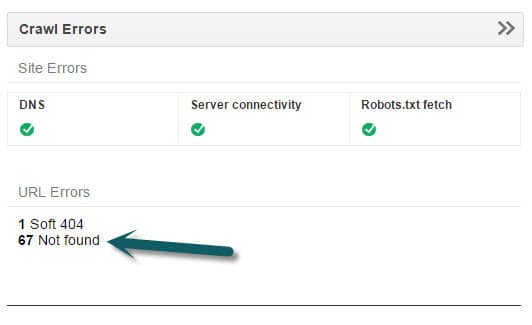
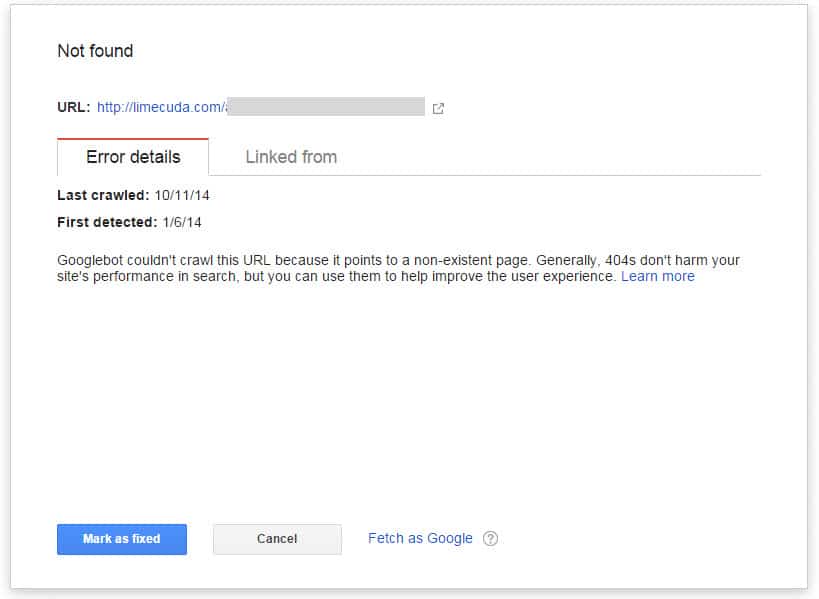
2) If you have your site verified in Google Webmaster Tools it will show you Error pages that it has found. This is a good thing to look at from time-to-time to try and keep that number near zero.

gwt
gwt-error

When you have fixed an error reported by GWT make sure to click “Mark as Fixed”.

3) Another option is to use Google Analytics. If you go to Behavior>>Site Content>>All Pages and do a search for 404 it might show you some pages people have hit that didn’t exist.

4) Not necesarily even a broken page on your site but using  brokenlinkcheck.com to scan your site may be another way to find error page and/or broken links.

5) Before ditching an old site we  create a list of all its pages. This tool, https://www.xml-sitemaps.com/ can scan your site and return a list of its pages. Use this option: “Download Sitemap in Text Format”

How to Remedy?

There are a number of methods for redirecting these but they all have in common that they need to be the 301 (Permanent) type of redirect.

1) If you use a typical Linux-type hosting running Apache you can use the .htaccess file which is found in the root of the site if you access it with sFTP.

In that file you can add lines like the below…

Redirect 301 ^/old-url/ http://limecuda.com/new-equivalent-url/

Pro Tip: To assemble all of these URLs with the “Redirect 301” you might want to use concatenation in Excel or if you use an amped up Notepad tool like Notepad++ you can do some clever tricks like the following to add “Redirect 301” in front of every line. This uses the regex caret symbol ^  which means “at the start of”.


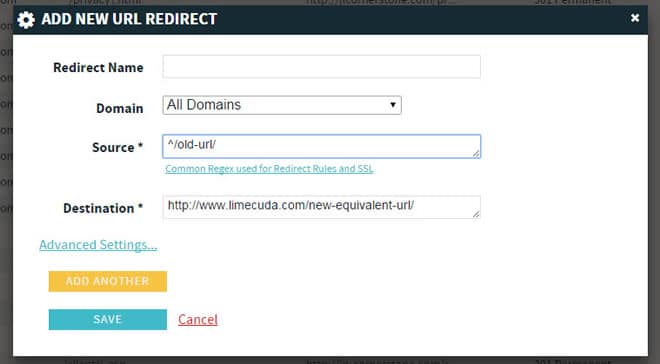
2) If you use a premium host like WPengine (runs many of our sites) then it might be running on nginx (pronounced “engine x”) in which case there might be a panel that looks like this…

redirect-nginx-404-pages


You may need some RegEx for properly redirecting some of these.


Now you know why error pages are a bad thing, how to find them, and how to fix them.

Have questions? Please ask in the comments!

How LimeCuda Uses Basecamp

We love Basecamp for Project Management. It helps us stay sane but more importantly we’re able to deliver a world-class solution to our clients in the most efficient way possible…every time, repeatedly, and consistently. Things get done quickly and correctly.

Back to where it all began, Grove City College

This past week we took a short trip to the birthplace of LimeCuda and my old stomping grounds, Grove City College.

Main reason for the visit was the former director of the Entrepreneurship department, Craig Columbus was speaking on “Living the Entrepreneurial Life”. It was a great talk and had a very genuine and frank feel. Some of the quick points from it off the top of my head:

  • Be an “abundance” thinker not a “scarcity” thinker. Don’t view profit as a pie to be divided but as a pie to be grown.
  • Conflict is inevitable you just need to learn to deal appropriately with it. Peace is not the absence of conflict but the presence of God.
  • Success is rarely a straight line. You will have many failures and that is ok.

It was an inspiring talk. Craig is a brilliant and humble entrepreneur.

Had a great time catching up with a peer I admire very much, Gray MacKenzie of Guavabox. Together we stormed one of Tim Sweet’s famous wing nights.

The next two days I spoke to a few classes:

  • Digital Marketing
  • The Entrepreneurial Mind
  • Internet Content Marketing
  • Ecommerce

I am not sure that people realize just how aggressively innovative the Entr Dept. at GCC really is. In the classes above and other they are learning how to leverage cutting-edge tech, not just things like Word and PowerPoint but WordPress, SEO, and how to write engaging content for online consumption, etc. This stuff is key, so much of modern business depends on understanding and successfully using technology.

Each time I go back I wish I could go through the program again, there are so many amazing classes. Simply amazing.

Big thank you to the Entrepreneurship Dept. for graciously hosting me again. It is always encouraging to be back and fills my tank with inspiration each time.

Here’s my son and I enjoying a Buffalo Chicken Tender Wrap in the Student Union. 

gcc-student-union


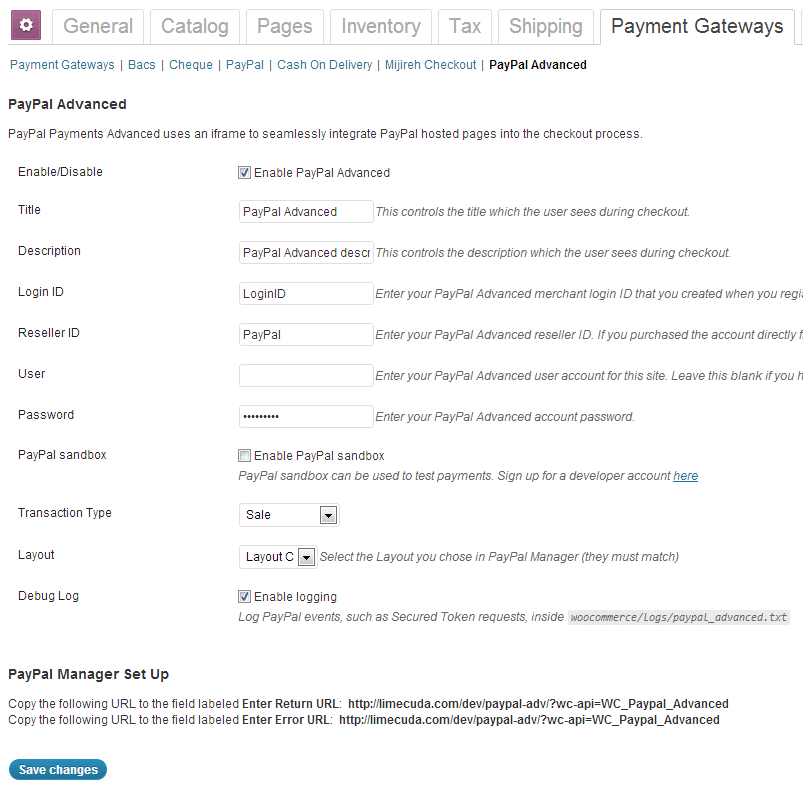
WooCommerce PayPal Payments Advanced plugin

PayPal Advanced

Introducing the PayPal Payments Advanced plugin for WooCommerce.

This is LimeCuda’s first major foray into the Premium WordPress plugin/extension market. We’re very excited!

So what does this do?

WooCommerce PayPal Advanced

This plugin combines two essential elements of an eCommerce cart checkout:

  1. a merchant account
  2. a payment gateway

It does all of this while keeping customers on your site for the entire checkout experience.  This means the user has a unified, branded experience throughout the entire purchasing process.

Key Features:

  • Unlike most on-site, seamless gateways this is only $5/month. Most cost at least $30/month whether you sell anything or not. (The cost can be this low cause PayPal has put their BillMeLater and PayPal Express checkout options along with it)
  • Simpler PCI compliance. Doesn’t require an SSL certificate (although it is recommended for higher user trust)
  • Works by using an iFrame to contain a checkout page hosted by PayPal
PayPal Advanced WooCommerce settings

Links

How the Mobile Web WILL Affect Your Business

There are some amazing new statistics about mobile phone usage.  With these numbers, there is no doubt that mobile must be a major aspect of small business’ web strategy and will only become more important.  In this next phase of Internet evolution, how will your business be affected?

At LimeCuda, our biggest pet peeve is seeing our clients and other small businesses getting wooed into spending lots of money in the pursuit of false hopes.  Although mobile design has a much lower risk of underhanded marketing activities than services such as SEO (we are not degrading SEO as a service, only certain SEO “experts” that do their clients more harm than good) there is still opportunity for salesmen to capitalize on the “need to get your site mobile” without putting the specific needs of your small business first.

Here are a couple of things to think about when considering the development of your approach to the mobile web.

Track YOUR Analytics!

Take a look at the statistics presented in the mobile marketing video above.  These statistics further show that mobile IS the current (and future) trend in Internet use. However, what is the trend for your website? Are your analytics showing you what you need to be focusing on a mobile site design? Or are your analytics telling you that your current web budget is better spent on SEO or Social Media strategies?  Just because there are a large number of people searching for local businesses from their phone, what good is it for your business to have a mobile website if you don’t even have a Google Place page?  Focus on your goals and utilize your budget to best reach these goals. Be tactical with your budget.

Mobile Analytics Examples from our Clients

Mobile Visitors from Jan 1st 2010 – April 30th 2012

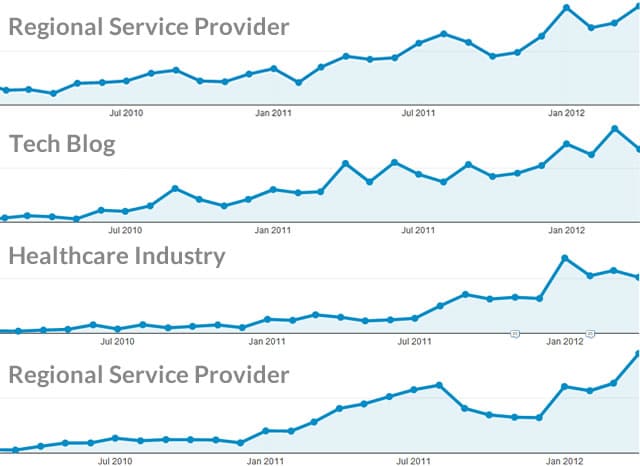
We ran some analytics reports from a few clients that have data going back to 2010. These are a good applicable sample.  Other clients’ analytics show similar trends. The below graphs show mobile visits over time. (each dot is a month)

mobile traffic analytics stats

First Four Months of the Year

(mobile as a % of total visits)

Year

Client A

Client B

Client C

20101.32%1.15%2.2%
20117.26%4.59%4%
201217.5%9.70%9.6%

You might say that 10% of your visitors isn’t massive but the trajectory is increasing. It is not a stretch to predict that by next year a solid third of your traffic might be mobile!

Have you determined your goals for being online?  
Do you know how to track and understand your analytics?  
We would love to discuss these issues with you directly!  Contact us today!

What are your customers looking for?

So you have determined that you need a mobile website now!  What next?

You need to determine what people are trying to accomplish when using your site from a mobile device.  This is definitely more difficult to determine and relies on educated guessing, however there are some great clues that can be found within the search terms and traffic flow in your analytics.

For example, imagine you run an upscale Italian restaurant in a major city (we’ll say Atlanta since that is the world outside my door right now).  A sample of your customer base might be:

  • Wealthy locals
  • Locals celebrating special events (anniversaries, engagements, etc.)
  • Tourists (everyone budgets at least one “fancy meal” for their vacations)
  • Business Travelers

Your website has an elegant design which entices the visitor with the feel and atmosphere they’ll experience when visiting your restaurant.  It showcases your world-class chef, large, elegant images of your featured dishes, and a quick way to contact or book a reservation.  What does a mobile user want to do?  Some possible intentions:

  • Get directions to your restaurant (they’re already in the car!)
  • Find your number to call
  • Book a reservation
  • Browse your menu
  • Find out if you have any specials running

While these are just educated guesses, your analytics might give you good insight into what the mobile user wants.  Why not give them this information more immediately, while still providing the same feel and atmosphere from the main site design?

Effective mobile web strategy must begin with knowing what is most helpful to the mobile browser.

Do you need a mobile web strategy?  Contact us today about developing and implementing your mobile strategy!

SEO Over-Optimization?

Keeping you in the loop on some interesting SEO changes from Google; we’ve got your back Jack.

Google search/spam guru, Matt Cutts, recently threw the SEO world into an upheaval when he said…

So all those people who have sort have been doing, for lack of a better word, “over optimization,” or overly doing their SEO, compared to the people who are just making great content and trying to make a fantastic site, we want to sort of make that playing field a little more level.

This is related to the so-called Penguin update to Google’s search algorithm that happened on April 24, 2012.

Should you be concerned?

If we have been guiding your SEO, you will be just fine. Here’s why… 

  • We have always emphasized user-centric SEO – if your content looks spammy, you are doing it wrong
  • One of the main purposes of our SEO is to accurately convey to machines and users what your content/site are all about
  • We never engage in shady or low-quality link-building tactics and those are part of what is getting hit hardest

This update may actually help many of you as it will level the playing field some.

Further Reading:

(are you a fan of us on Facebook? Like our page to keep up-to-date on new changes in the Web industry)