Website Security – A Breakdown of How We Approach WordPress Security

Join us through a deep dive of how we approach the security of the WordPress websites we host.
Join us through a deep dive of how we approach the security of the WordPress websites we host.
Enterprise websites are never “set it and forget it” properties. They need to be regularly backed up, monitored, updated, and maintained.
Use this post to do an audit and determine if your site is on stable ground.
There are many great solutions out there. We carefully tailor a hosting setup for each client that involves sometimes dozens of tools working in harmony to create an optimal hosting and maintenance setup for WordPress.
It all begins with a properly architected server setup. This is basic – just like having deadbolts on your doors and locking your windows.
Things we look for (and provide) in our enterprise WordPress-specific hosting:
The biggest security risk in WordPress is not having the codebase updated to the latest versions. This includes the WordPress core, plugins, and the theme. In recent security reports, the majority of WordPress-related hacks are due to sites using outdated versions of WordPress or outdated plugins that have had vulnerability patches publicly available for well over a year.
We use site management tools that let us update all our client sites at once and within minutes of a security patch being released.
In this case, for “maintenance” we’re not referencing retainer-type work where active feature improvements are being made to the site. Think of maintenance as the aforementioned regular updates being performed but with a careful eye to making sure the site keeps working as it should.
Conflicts are pretty rare but in an enterprise-context, a key feature failing could mean serious lost revenue or at a minimum a black eye on the brand reputation.
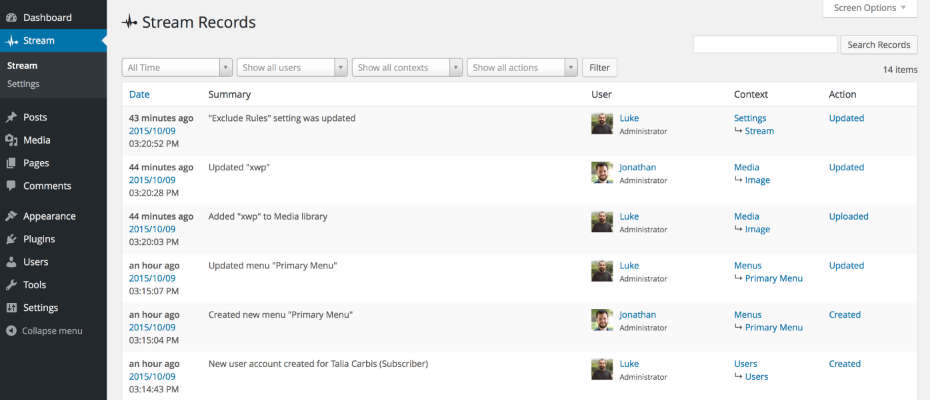
We use a brilliant plugin called Stream that is basically a black box for WordPress. It records all the stuff that happens on the backend of the site. This is really useful for tracing back what went wrong. It let’s you see who-did-what-and-when.
A security update should usually be applied immediately. Non-critical updates and feature releases are better applied at set intervals (like once a month or every two weeks) That way these can be done on a staging site, or when the site has low traffic. Once a batch of updates is applied it is then efficient to go through an extensive QA list to ensure the sites look and functionality is still perfect.
Tip:
Do you have a staging area that you’re able to test your plugin updates to make sure everything is going well before running those updates (or migrating your staging) on live?
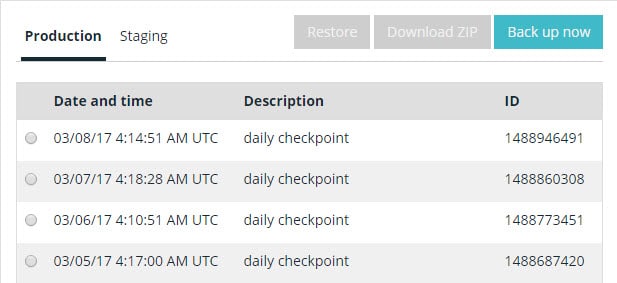
Regular, full, off-site, and redundant backups need to be maintained with the ability to restore a site at any point in time.
If something ever goes wrong you need a quick way to restore!
How often a site is backed up will be dependent on the type of site you’re hosting. For example, a corporate blog with daily posts would probably be adequately served by a daily backup. However, a high-volume, e-commerce site really needs a real-time backup solution to protect a complete list of customer transactions.
We use a couple backup solutions but at a minimum we utilize WPENGINE’s daily automatic backups.
VaultPress has a great real-time backup feature for business-critical / E-Commerce sites. Additionally there is constant malware detection and this is a sweet deal.
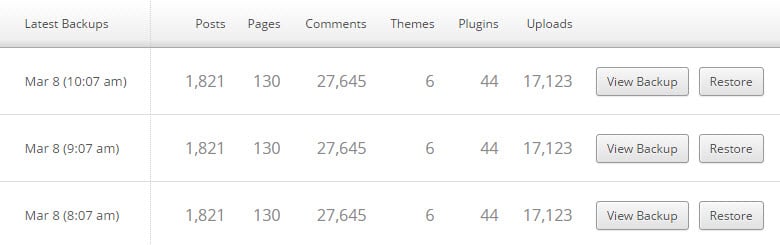
For enterprise websites on WordPress, there are four types of monitoring:
For uptime monitoring, the aim is always 100% uptime. But we live in a very complicated world with many moving parts and human error. (see recent Amazon S3 downtime due to a wrong keystroke)
Uptime Robot is a good monitoring tool that lets you send alerts to emails, texts to phones, RSS, updates in Slack, etc.

We use a combination of tools but an absolute key is to have the site being tracked in Google Search Console. This is free and it will email you if your site is ever suspected to be compromised. Google is very careful about sending search traffic to malware-infested sites. (Pro Tip: connect Google Analytics and Google Search Console).
If you are needing a one-off check to see if your site is clean, try the Sucuri SiteCheck tool.
Sucuri also has a good plugin to manage WordPress Security
There are tons of great tools and ways to do this. (Google Analytics of course) Analytics and traffic measuring tools can also be used to alert you to all kinds of problems with your site being down or having malware.
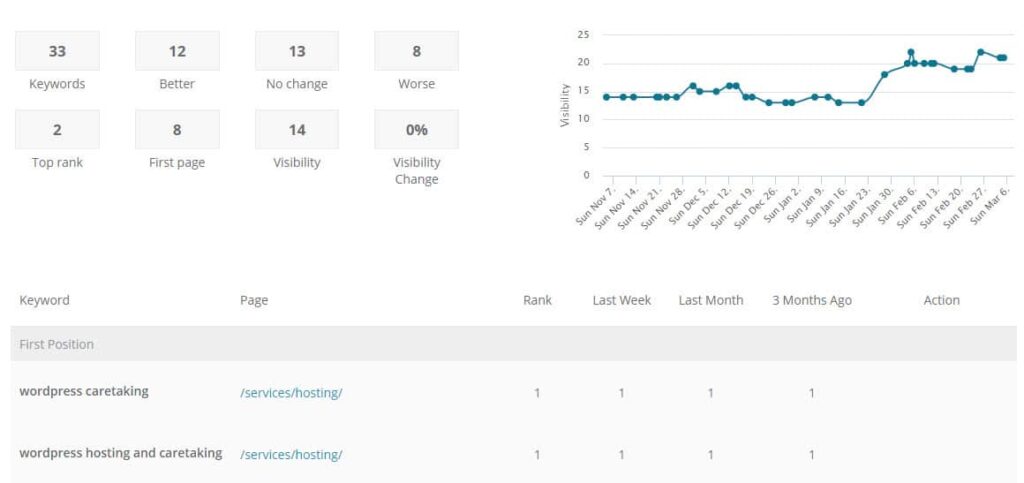
Being able to see keyword rankings can also be key to monitoring the site’s ongoing success.
It isn’t enough to know that your site is up – it also needs to be loading quickly! We have alerts to head off any issues if a site starts loading sluggishly.
A good quick test for site speed is the Pingdom Website Speed test.
Around 6 years ago very few sites were mobile-friendly. We’ve had a revolution and now every website needs to be usable and pleasant experience on mobile.
In similar fashion, we’re at a turning point for all websites being “secured” (HTTPS) using SSL Certificates.

It is basically a protocol that means any traffic to-and-from your website is encrypted and if it is intercepted it cannot be understood.
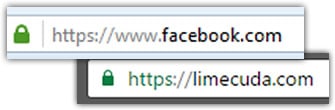
Your site either gets accessed using HTTP or HTTPS. The secure version, HTTPS will usually show a trust-gaining green lock in the browser. The “S” in HTTPS stands for “Secure” – it should all makes sense now…
If you visit an unsecured website and fill out a contact form while on McDonald’s WiFi, anyone else on that network can see all your traffic and what you submitted – if the site is not HTTPS. You can see how this is a problem!
In an effort to encourage best practice and protect their users, Google sees sites being secure as a minor ranking signal. Ranking for keywords is hard, this could give you a small boost.
The Chrome browser team recently announced that starting in January there will be insecure warnings on site login pages that aren’t SSLed. This could be a blot on your brand and isn’t a good reflection to the user. In the future it seems likely that securing an entire site will be best practice.
Having that green lock in the browser and seeing that your site is secured may help users trust you more highly if this is their first impression.
Even if you aren’t collecting credit card details, SSNs, or private details…you want to guard your users. Sometimes little details could help a hacker build a profile on them and do something nefarious. We’ve even had clients whose customers couldn’t access an insecure site – usually for industries like military or government. If your site isn’t secure, your users’ traffic is wide open to any governments, shady monitoring outfits, and hackers.
While the WordPress Dashboard / admin area does have some security features, you are still transmitting your logins insecurely when you login and are making changes to your site.
I don’t need to even say why that is an awesome thing. The technologies that work with HTTPS and your browser now mean that an SSL certificate won’t slow your site down but could actually make it faster for users!
Migrating from HTTP to HTTPS is becoming inevitable. There is so much value in switching that it is already a no-brainer.
If your WordPress site is not secured and able to use HTTPS, reach out to us and we can create a plan to migrate. Typically the certificates cost $50-250/year. However, you can now get an SSL Certificate for free using Let’s Encrypt. We use SSL for all new WordPress hosting accounts, it is becoming a must-have feature.
